Friday, May 24, 2019
2019 Endangered Places Progress Award - Gold Medal Orchard
Congratulations to the Montezuma Orchard Restoration Project (lovingly known as MORP), for working to preserve these wonderful old trees that were planted in McElmo Canyon in the shadow of the Sleeping Ute Mountain.

Friday, August 31, 2018
Fires at Glacier National Park

Thursday, August 3, 2017

Wow, the Federal Historic Tax Credit program is really thriving. The National Park Service recently released figures for tax credit activity between October 1, 2015 and September 30, 2016. Tax credit activity hit a record $1.2 billion in certified credits, which is an increase of 32 percent over the previous year. The Historic Tax Credit program is associated with the creation of 109,000 jobs, with a $6.2 billion impact on the gross domestic product.
.
Friday, October 14, 2016
"Re-urbanism" Preserves History, Conserves Energy And Enhances The Local Economy
 |
| The Western Colorado Power Company office building in Durango is now home to the Durango Coffee Company |
Historic buildings convey an authentic sense of the community's history and character. They are billboards for the roots of the community and they tend to attract entrepreneurial and creative industries. Real estate studies show that historic buildings in and near historic districts are valued at about 20% higher than their counterparts.
The National Trust for Historic Preservation-a long time advocate of rehabilitating historic buildings-has a program called "Reurbanism" that champions adaptive reuse of historic buildings. Two of their ten principals are;
Older places provide the distinctiveness and character that engender success. Older buildings give cities a sense of identity, history, and authenticity—which is the most important competitive advantage they can have in today’s economy.
Older neighborhoods are economic engines. Research shows that neighborhoods with a mix of older and newer buildings perform better along a number of social, economic, cultural, and environmental metrics than areas with only new buildings.
If you want to learn more about Re-urbanism, click on this link National Trust Reurbanism. Architect Rick Feeney just shared a great article about this movement in Denver. This link at Colorado Biz will take you to the article.
Sunday, May 8, 2016
Putting the Grand Back into the Grand Imperial
 |
Al Harper, the owner of the Durango and Silverton Narrow Gauge Railroad is dressed in period clothes as he welcomes visitors to the celebration of the restoration of his Grand Imperial Hotel.
|
 |
| Brr-Glad we brought our down coats. |
 |
| New wallpaper and carpet in this glamorous lobby. Don't you love the portrait of
starlet Lillian Russell on the wall?
|
Wednesday, May 4, 2016
Tune Into KSJD on Friday
 |
| KSJD Public Radio broadcasts from the historic Montezuma Valley Bank and Store in Cortez, Colorado |
On Friday, May 6, KSJD Radio will air a short interview I did with Tom Yoder about historic preservation and the ongoing historic building survey in Cortez, Colorado. They told me the interview will air on Friday during a break in NPR's Morning Edition at 7:30am (MDT). You can stream KSJD at ksjd.org . Click onto the Listen Live" button on their website.
Friday, April 8, 2016
Here's something really fun to do.
|
||
|

Friday, January 15, 2016
Modernism Again

I am re-posting this piece, as more and more of my work addresses this not so distant period of time.
Well I guess it had to happen. Sooner or later your past catches up with you. I was born in the height of the craze for modernism and now I'm making part of my living by documenting it.
All of those ranch homes, and odd shaped bank buildings, and strip shopping centers that sprang up after World War II are now more than 50 years old, which means they are old enough to be considered for most community and state historic registers, as well as the National Register of Historic Places.
So much concrete, so many prefabricated aggregate panels, so much steel. Modernism was everywhere--even in our National Parks as part of their Mission 66 program, which funded the largest building program in the National Parks from 1956 to 1966. Modernism in our rustic parks? Well yes. Think about the round, concrete visitor center at Mesa Verde National Park, which has recently been vacated for new digs. Even the venerable Grand Canyon National Park encouraged modernist style buildings, like the Thunderbird and Kachina Lodges that are tucked in near the venerable El Tovar.
Everything in those days touted all of our modern conveniences and most particularly our cars.
We Americans were crazy about the automobile. Our lives revolved around our cars. We constructed huge parking lots and oriented our lives, our businesses and our buildings to the street curb. We loved drive-thrus of all kinds--banks, fast food, and in New Mexico we even had drive up pay phones. Now that's an anachronistic concept. I can't imagine ever seeing a millennial sitting in a car or using a pay phone.
So I see the need to document and celebrate a piece of our history that revered technology and seemed so distant from the natural world. But I'm glad that time is now past.
If you want to know more about my work, scroll through this blog or check my site at Linked In
Monday, June 8, 2015
History Talks!
 |
| The Mexirado Building in Cortez was constructed in the 1920s on the site of Perley Wasson's old stable. |
Located just down the road from Mesa Verde National Park, Cortez boasts its own fascinating history as a water town. It was created as part of a grand scheme in the 1880s to develop real estate by diverting water from another drainage to this arid region. While local cowboys and the Ute Indians explored the cliff dwellings that would eventually become part of Mesa Verde National Park, the little town of Cortez set down roots and started to grow.
There is a lot of interest in honoring the local history of Cortez. Residents of the Montezuma Avenue neighborhood are moving towards establishing a historic district. This would be the very first historic district in this town that has many hidden gems. I've just finished a survey of buildings within the original townsite, If all goes well, the commercial buildings on Main Street will be next.
Many thanks go out to KSJD Radio for their coverage of local Cortez history. If you want to know more about my work, scroll through this blog or check my site at Linked In.
Sunday, May 10, 2015

Saturday, February 28, 2015

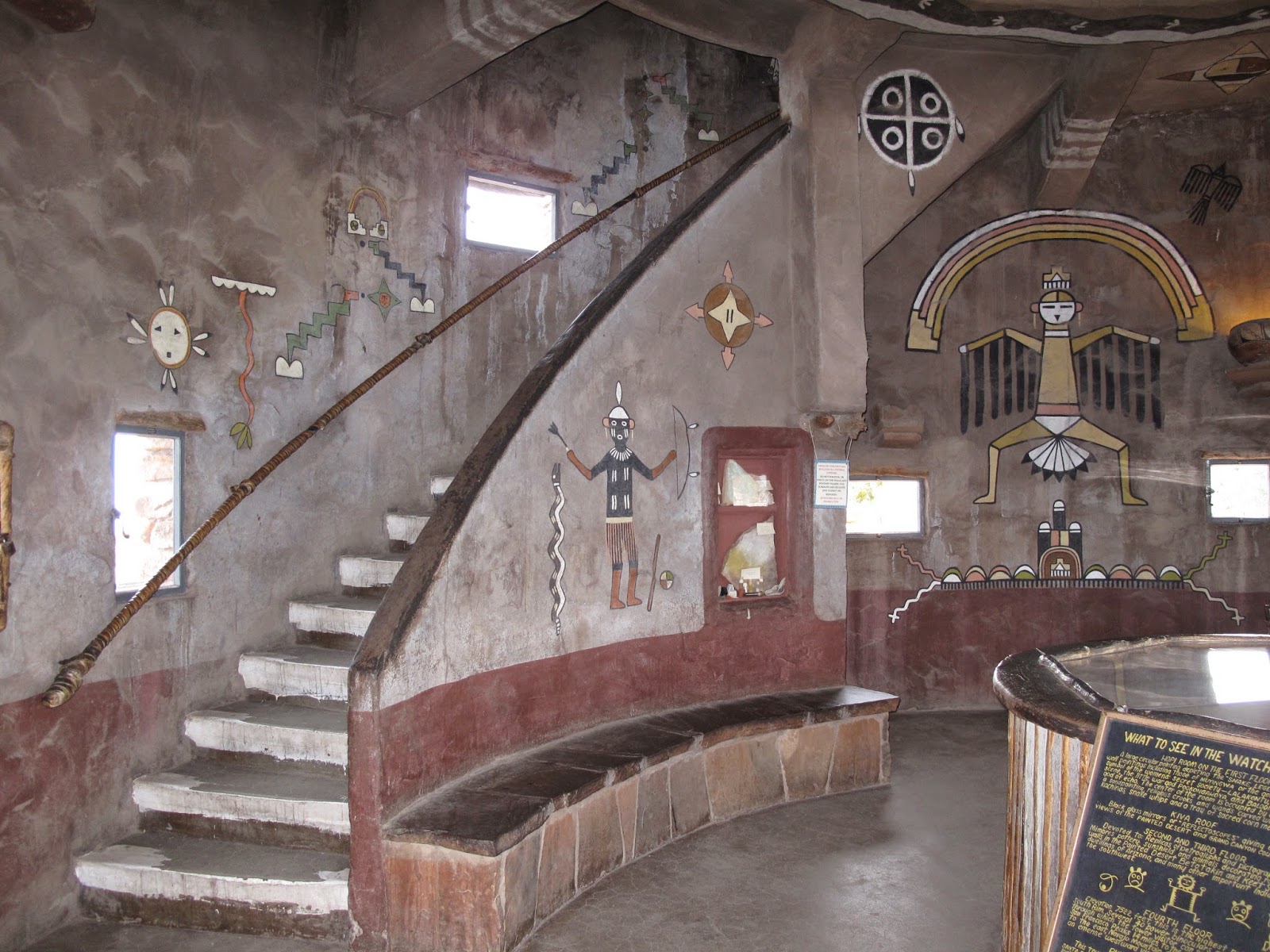
My current projects include historic research on some spectacular buildings at the Grand Canyon National Park. Did you know that this tower, called the Watchtower, was designed by Mary Colter based on her extensive research of Hopi culture and construction traditions? It's quite a place. Here's a photograph of the interior...
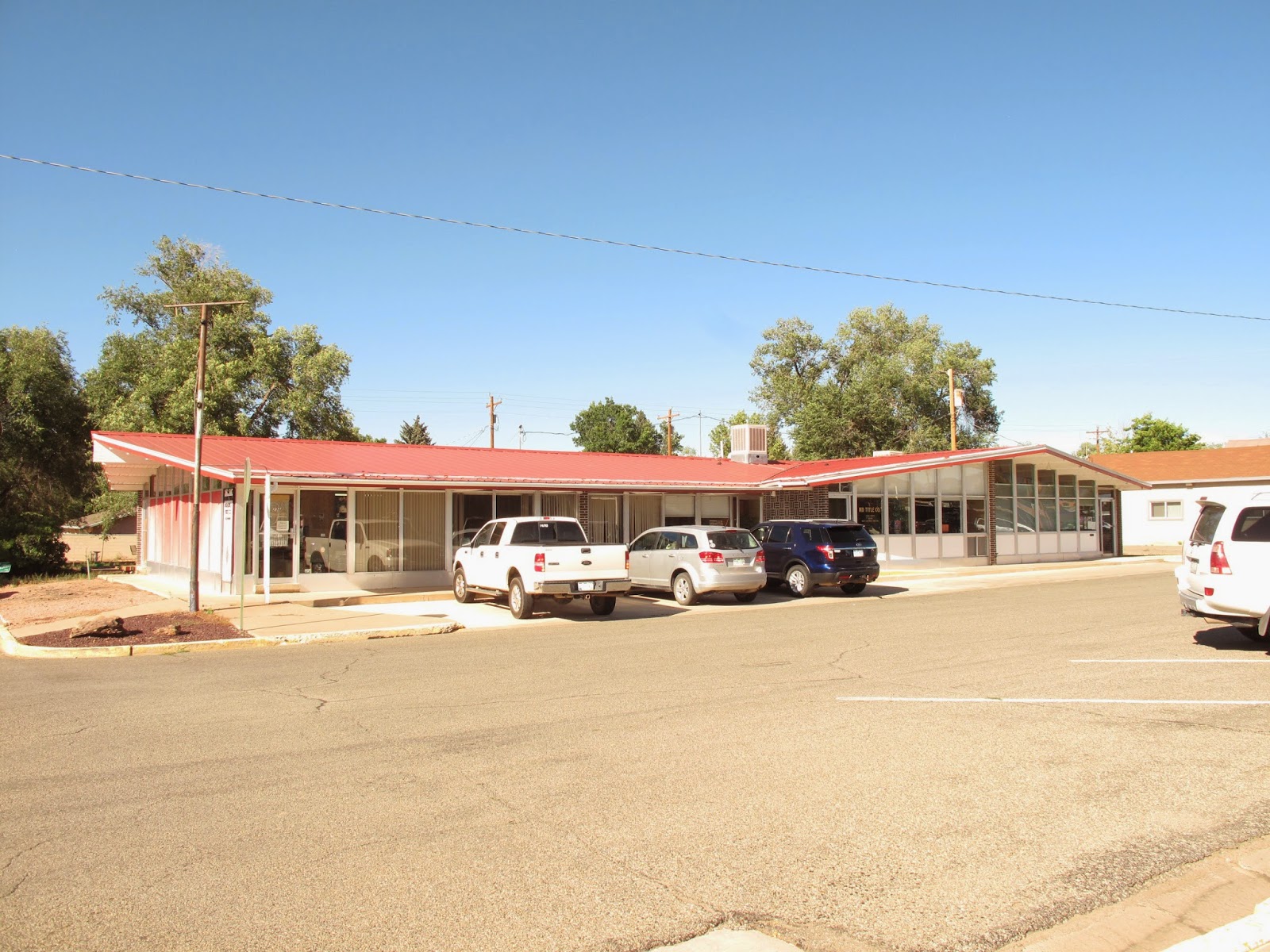


I'm also continuing the historic building surveys in Cortez, Colorado, an interesting small town in southwest Colorado, located just a few miles from Mesa Verde National Park and the lands of the Ute Mountain Utes. This town has everything from cute little bungalows to the mid-century modern office buildings. I really like the one below.
In addition to fascinating archaeology and fun mountain biking, Cortez and Montezuma County are welcoming new kind of agriculture that emphasizes the small farm and the farm to table movement. Cortez residents are also looking into establishing a historic district along Montezuma Avenue, and I'm helping with that.
Here's another unique and special place. The Animas City Cemetery is the oldest cemetery in La Plata County. It's tucked onto bench on the steep slopes below Fort Lewis College.
The cemetery is home to the graves of famous outlaws, early homesteaders, Civil War veterans and, sadly, the many children who died very young. Although the property has been owned by the City of Durango since 1985, they have done nothing to preserve the headstones or care for the land. A support group--The Friends of the Animas City-- has been working to conduct research and work with the City to develop a maintenance plan and repair the most damaged headstones. For more information, check out the great website with information about the Cemetery and the people buried there at http://www.animascitycemetery.org/
Wednesday, November 5, 2014
History Comes Alive at the Animas Museum in Durango
The Animas Museum, which is the best source for local history related to Southwest Colorado, is in the middle of a project to photograph and digitize information about their impressive collections. I've been lucky to be a part of it. This project will make it possible to research almost any topic represented by the items in the Museum's Collections. Click on this link to their website, Animas Museum Collections to learn about this great project.
Friday, July 11, 2014
Vacant, Not Blighted. Heritage Matters in Detroit
Check out this great video from the Michigan Historic Preservation Network. What a heartfelt plea to Detroit to think hard about their history. I particularly liked the man who talked about restoring a porch in 25 degrees temperatures and knowing his work would be around for another 100 years. Here's the link. http://vimeo.com/96926735
Tuesday, May 20, 2014
At Home in the Past is now The Historical Consultant
I've changed the name of my blog to match the website address for my business. My old website at www.thehistoricalconsultant.com will be discontinued in 2015, and online traffic will be directed to this blog. Check out upcoming posts on this blog for more information about my business, Cultural Resource Planning, and our great projects!
I'm still working in Durango, Colorado, as a historical consultant and doing fascinating projects in history, architecture, historical archaeology, research and historic building surveys. Right now I'm conducting a new historic building survey in Cortez, Colorado. This project is the third phase of a multi-year project to document and record the historic buildings in the interesting little town in southwest Colorado. As the gateway community to Mesa Verde National Park, Cortez offers a small rural community lifestyle and a really fascinating history of water development against a backdrop of Ancestral Puebloan, Ute and Navajo cultures.
In Durango I'm working with the Animas Museum to document the histories of the objects in their collections. This project highlights some of Durango's important historic families whose contributions to the Museum range from antique saddles, to Ute beadwork to historic farm implements. The Museum has received a Museums for America grant from the Institute of Museums and Library Services.
I'm still working in Durango, Colorado, as a historical consultant and doing fascinating projects in history, architecture, historical archaeology, research and historic building surveys. Right now I'm conducting a new historic building survey in Cortez, Colorado. This project is the third phase of a multi-year project to document and record the historic buildings in the interesting little town in southwest Colorado. As the gateway community to Mesa Verde National Park, Cortez offers a small rural community lifestyle and a really fascinating history of water development against a backdrop of Ancestral Puebloan, Ute and Navajo cultures.
In Durango I'm working with the Animas Museum to document the histories of the objects in their collections. This project highlights some of Durango's important historic families whose contributions to the Museum range from antique saddles, to Ute beadwork to historic farm implements. The Museum has received a Museums for America grant from the Institute of Museums and Library Services.
Tuesday, March 11, 2014
Agritourism in Colorado
Colorado agritourism welcomes locals and visitors to connect with their heritage through its agriculture. The Colorado State University Extension Office reported in 2006 that more than 13 million visitors spent $2.2 billion in such agritourism activities as farm visits, farmer's markets and winery tours, rodeos or stock shows and horseback riding.
You can enjoy some of our agricultural heritage on March 13-15 in Cortez at the Four States Agricultural Exposition. Now in its 32nd year, this event is held at the Montezuma County Fairgrounds. Some of my favorite events are the antique tractor show and tractor pull, and the stock dog exhibitions. This year I may take in a session on pack mules and packing techniques from veteran Federal Government packer, Glenn Ryan, or maybe the forum on wildfires and fire management.
If you are in the Four Corners, come by Cortez and check it out.
You can enjoy some of our agricultural heritage on March 13-15 in Cortez at the Four States Agricultural Exposition. Now in its 32nd year, this event is held at the Montezuma County Fairgrounds. Some of my favorite events are the antique tractor show and tractor pull, and the stock dog exhibitions. This year I may take in a session on pack mules and packing techniques from veteran Federal Government packer, Glenn Ryan, or maybe the forum on wildfires and fire management.
If you are in the Four Corners, come by Cortez and check it out.
Friday, December 20, 2013
Rolling Down the Tracks with Steam Powered Locmotives
"Trains" seemed to be the theme for me for 2013. I enjoyed a season pass on the Durango and Silverton Narrow Gauge Railroad and rode a number of times in spring, summer and fall. Next up is a ride on the winter train over the holidays.
I also got a ride on the inaugural run of the recently restored Locomotive 463 on the Cumbres and Toltec Scenic Railroad. What a treat to see that vintage engine all steamed up and puffing from Antonito to Chama.
I also got a ride on the inaugural run of the recently restored Locomotive 463 on the Cumbres and Toltec Scenic Railroad. What a treat to see that vintage engine all steamed up and puffing from Antonito to Chama.
 |
| Here's a survivor from the Denver and Rio Grande Western Railroad all ready to go in the Antonito yard. |
This fall, my husband and I travelled to Strasburg, Pennsylvania, where we took a short railroad excursion through cornfields and the Amish farmland. Strasburg is home to the magnificent Railroad Museum of Pennsylvania . I've never seen so much rolling stock from so many eras of American Railroading all under one roof.
 |
| Getting the locomotive ready in Strasburg |
 |
| I loved this beautiful blue engine at the Railroad Museum of Pennsylvania. |
Monday, July 29, 2013
New Historic Byway

Southern Colorado and northern New Mexico are home to the last surviving remnants of the great Denver and Rio Grande Narrow Gauge Railroad. The Durango & Silverton and the Cumbres & Toltec Scenic Railroad, two National Historic Landmarks, operate on parts of the line and now they are sponsoring an effort to create an automobile byway along the route of the railroad that once connected their two depots at Durango, Colorado, and Chama, New Mexico.
Lucky me, I've been hired to oversee this effort. A new byway would be the 26th in Colorado and would extend a shorter segment of one of the 25 in New Mexico. The route is really fascinating, travelling through old farming settlements, into some pretty wild country along the Navajo River and across both the Southern Ute and the Jicarilla Apache Reservations. The Tribes have offered their support, along with the counties and cities in New Mexico and Colorado.The bridge in the photograph above is a survivor from the old D&RG Railroad route. I'm really looking forward to working on this great project.
I've put together a website to keep people updated about the progress of the railroad byway project. You can find it at www.railroadbyway.wordpress.com . Or you can check back here or at my website at www.thehistoricalconsultant.com for more information.
Here are links to the two railroads. The Durango & Silverton, which provides service between the two towns in its namesake in vintage passenger cars pulled by vintage locomotives is at www.durangotrain.com . The Cumbres &Toltec Scenic Railroad operates between Chama, New Mexico and Antonito, Colorado, along a spectacular route with historic steam locomotives. Check them out at www.cumbrestoltec.com .
Wednesday, May 15, 2013
Thanks to San Juan Dryland Radio!
Thanks to KSJD (yes that is K- San Juan Dryland) Radio, I was able to work with Linda Towle and the Cortez Historic Preservation Board to talk about history and historic preservation projects in Montezuma County. They have a lot going on there, from restoring the last remnant of the old Montezuma Water Company Flume, to helping place a historic grain silo on the Colorado Engangered Places List, to encouraging property owners to list their important historic homes on the Cortez Historic Register. The radio station is located in one the town's beautiful historic stone buildings that once was the home of the Montezuma Valley Bank. Listen in to our conversation at http://www.ksjd.org/audio.cfm?mode=detail&id=1243553663342
Thursday, December 27, 2012
Family Roots and Architecture

Sunday, December 9, 2012
Wooden Skis and Deep Canyons
If you are a fan of canyon country or old time skiing in Utah, check out these two new books. I have an inside scoop on both books because the authors are good friends with great stories to tell. In "Wooden Skis", you can read all about the founding and development of the unparalleled ski area of Alta, Utah. Kim Morton tells the tales of her father, the legendary Chic Morton, and his lasting impact on Alta. Kim has mastered the burden (and honor) of being the child of a famous figure in ski area history, by carving out her own place in the world of skiing. She is a ski professional who was nationally honored as "Ski Instructor of the Year", complete with a rather strangely out-of-place recognition ceremony in New York City. Do they ski there?? Her book is available on Amazon. Also at Amazon (thanks to their self-publishing program) is a wry book about the history of Trail Canyon, a beautiful place located southwest of Cortez near the Canyon of the Ancients National Monument. This is no nature book. While it introduces you to the beauty of the country near McElmo Canyon, this volume is full of wonderful anecdotes about the people who have attempted to live in this very demanding place. The book is called "Trail Canyon: 6 Miles Long, 10,000 Years Deep." The major four instigators of the book, nicknamed the odd quad, share their stories with the help of a local Durango writer. Look for it on Amazon under the title or via the lead writers, Howard "Bud" Poe and Ann Butler.
Subscribe to:
Posts (Atom)